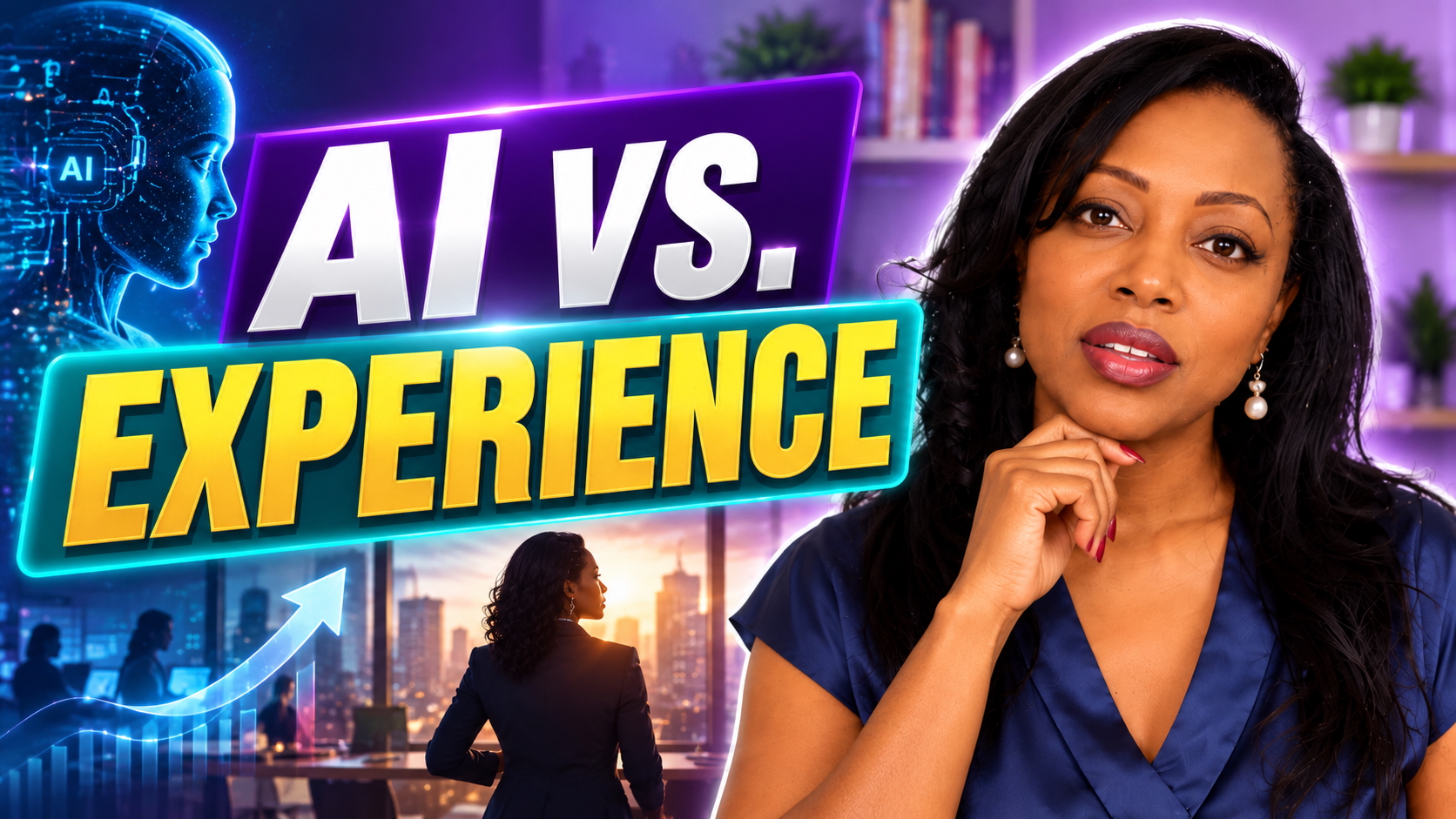
AI is changing jobs. And if you’ve spent the last 10, 20 or even 30 years building your career, you may be wondering what that means for your future.
Well, let’s face it. The job market has changed. Companies are restructuring, AI skills are appearing in job descriptions, and professionals everywhere are hearing the same message:
Learn AI. Adapt. Upskill. Prepare for the future of work.
But here’s something interesting.
While much of the conversation focuses on artificial intelligence replacing experienced workers, emerging research suggests a more complicated picture. In certain occupations highly exposed to AI, younger workers are experiencing greater employment pressure than their more experienced counterparts.
Meanwhile, research from PwC suggests that as AI makes some kinds of expertise easier to replicate, human judgment, leadership, creativity, and contextual understanding may become even more valuable.
So perhaps the question isn’t simply whether AI will replace your job.
It’s whether your experience could become one of your greatest advantages in an AI-powered workplace.
And there’s a catch: experience alone isn’t enough.
What the Research Actually Says About AI and Jobs
There’s no shortage of alarming headlines about AI replacing workers. But the available evidence deserves a closer look.
Researchers at Stanford University’s Digital Economy Lab have analyzed payroll data covering millions of U.S. workers to understand how employment patterns are changing in occupations exposed to artificial intelligence.
Their findings don’t establish widespread, economy-wide job displacement caused by AI.
However, they have identified a notable pattern among younger workers.
In highly AI-exposed occupations, employment among workers ages 22 to 25 was approximately 19% below where it would have been had it kept pace with young workers in less-exposed occupations.
More experienced workers did not show the same employment pattern.
Importantly, this doesn’t mean AI directly caused a 19% reduction in employment among young professionals. The research identifies an association, not definitive proof of causation. Broader economic conditions also influence hiring.
Still, the findings raise an important question:
Could professional experience provide an advantage as AI transforms the labor market?
Source: Stanford Digital Economy Lab — Canaries in the Coal Mine
AI Can Access Information. But Is That the Same as Experience?
One of the most interesting distinctions in the Stanford research involves two forms of knowledge: codified knowledge and tacit knowledge.
Codified knowledge: What can be documented
Codified knowledge is information that can be written down, organized, taught, and reproduced.
Think textbooks, instruction manuals, procedures, training materials, and standardized processes.
These are precisely the kinds of information that AI systems can increasingly process and use to perform certain tasks.
Tacit knowledge: What experience teaches you
Tacit knowledge is different.
It’s the understanding you develop through years of doing the work, making decisions, navigating challenges, and learning from experience.
It’s knowing that what a policy says and what actually happens inside an organization can be two completely different things.
It’s recognizing that the problem everyone is discussing in a meeting isn’t necessarily the real problem.
It’s knowing when not to send an email.
It’s anticipating how a client might respond, navigating a crisis, or making a judgment call when there isn’t a perfect answer.
You don’t develop all of that simply by reading a textbook.
You develop it through experience.
And while AI can process enormous amounts of information, information isn’t automatically the same thing as wisdom, judgment, or contextual understanding.
That’s why experienced professionals shouldn’t automatically assume that their years of learning have become obsolete.
The challenge is learning how to use that experience differently.
AI Is Making Some Skills Easier to Replicate — and Others More Valuable
PwC’s 2026 Global AI Jobs Barometer examined more than one billion job advertisements across six continents.
Its findings describe a two-track labor market emerging as organizations adopt AI.
In some occupations, AI is democratizing expertise—making it possible for people with less specialized experience to perform tasks that previously required more training.
For example, AI can help produce first drafts, summarize lengthy documents, analyze information, and automate routine processes.
That understandably raises concerns for professionals whose work has traditionally involved those activities.
But PwC also identifies another category: professionalized jobs.
In these roles, AI handles more routine execution while human responsibilities increasingly emphasize leadership, creativity, judgment, and decision-making.
PwC reports stronger employment and wage-growth patterns in these professionalized roles than in roles where AI primarily makes existing expertise easier to reproduce.
This suggests that AI may be changing not only which tasks we perform, but also which aspects of our professional value become more important.
Instead of asking only, “Will AI take my job?” consider a different question:
Which parts of my value can AI reproduce—and which parts become more valuable because AI exists?
Source: PwC — 2026 Global AI Jobs Barometer
Why Does Everyone Keep Talking About the Future of Work in 2030?
You’d think we’re all going to wake up on January 1, 2030, and discover that robots rearranged the office overnight.
Fortunately, that’s not how workforce transformation happens.
The year 2030 is frequently used as a forecasting horizon by organizations studying the future of jobs, skills, technology, and economic change.
The World Economic Forum’s Future of Jobs Report 2025 projects significant changes in the skills workers will need by 2030.
Among the skills expected to grow in importance are AI and big data, technological literacy, creative thinking, resilience, and adaptability.
LinkedIn has similarly examined how the skills required across occupations are changing, with AI accelerating that transformation.
But these are forecasts—not prophecies.
Nobody knows exactly what your job or mine will look like in 2030.
The important takeaway isn’t that you have a deadline to reinvent your entire life.
It’s that the work is already changing.
And we can begin adapting now.
Sources: World Economic Forum — Future of Jobs Report 2025 and LinkedIn — Work Change Report
The AI Contradiction: Slow Down the Technology, Speed Up the Humans
Here’s something I’ve been thinking about.
Some AI researchers and technology leaders have called for greater caution, stronger safeguards, and even slowing certain forms of advanced AI development.
Meanwhile, workers are receiving an entirely different message:
Speed up. Learn AI. Become AI literate. Change how you work.
We’re debating whether AI itself needs to slow down while telling humans they need to hurry up.
And that creates a real dilemma.
AI is already embedded in business software, organizational workflows, and everyday professional expectations.
So while conversations about AI safety and responsible development absolutely matter, professionals cannot necessarily wait for those debates to be resolved before making decisions about their own careers.
That doesn’t mean chasing every new AI tool.
It means developing enough understanding to make informed decisions about how technology fits into your work.
Experience Alone Won’t Protect Your Career
Before my fellow experienced professionals get too comfortable, there’s something else we need to acknowledge.
Experience alone isn’t enough.
The skills employers need are changing. AI literacy is becoming increasingly relevant across professional roles.
You don’t necessarily need to become an AI engineer or master every platform.
But you should understand what AI can do, where it can improve your work, what should remain under human oversight, and where your expertise is essential.
Think about it this way:
If everyone has access to ChatGPT, Claude, Gemini, and whatever comes next, simply knowing how to open an AI chatbot isn’t much of a differentiator.
What you can do with it might be.
Your New Career Advantage: Expertise + AI Literacy + Human Judgment
Here’s how I’m thinking about the future of work for experienced professionals.
Your advantage isn’t just your experience.
And it isn’t just AI.
It’s the combination:
Your expertise + AI literacy + human judgment.
Your expertise helps you recognize patterns, understand context, anticipate challenges, and identify the real problem.
AI literacy helps you use technology to accelerate appropriate tasks, explore ideas, and improve productivity.
Human judgment helps you evaluate outputs, make decisions, build trust, and recognize when the technology doesn’t have the full picture.
Together, these capabilities can help you contribute in ways that go beyond simply producing more work.
And here’s something we often overlook: experienced professionals sometimes undervalue the very skills they’ve spent decades developing.
Reading a room. Navigating organizational complexity. Leading through uncertainty. Recognizing when the obvious answer is wrong.
We assume everybody knows how to do these things.
Everybody doesn’t.
Three Ways to Make Your Experience More Valuable in the Age of AI
1. Audit your expertise
Start by looking beyond your job title.
What problems do people consistently come to you to solve?
What can you recognize today that you couldn’t recognize 15 years ago?
What have your successes, mistakes, relationships, and professional experiences taught you?
These are clues to the expertise that differentiates you.
2. Audit your work for AI
Look at the tasks you perform each week.
Which could AI help you complete faster? Which could it help you brainstorm, organize, summarize, or analyze?
And which require your personal judgment, relationships, ethical consideration, or understanding of context?
The goal isn’t to automate everything.
It’s to use AI where it makes sense so you can devote more time to the work that requires the highest level of you.
3. Learn to articulate your value differently
Saying “I have 20 years of experience” isn’t necessarily enough anymore.
Twenty years doing what?
What do those years allow you to see, solve, anticipate, or understand?
How does that experience help you make better decisions?
And what becomes possible when you combine it with AI?
That’s the story employers, clients, collaborators, and potential business partners need to understand.
It’s also the foundation of a compelling personal brand.
The Product Is YOU — and That Matters More Than Ever
Long before generative AI became part of our everyday conversations, I built a program around a principle I still believe:
Your expertise. Your experiences. Your perspective. Your creativity. Your relationships. Your story.
And as AI becomes more accessible, I believe that principle becomes even more relevant.
When more people can access similar technology, the technology itself may become less of a differentiator.
What matters is what you bring to it.
Your years of experience aren’t automatically obsolete because AI can perform certain tasks.
But you may need to package that experience differently, combine it with new capabilities, and communicate its value more clearly.
So instead of asking only, “How do I protect myself from AI?” I encourage you to consider:
How do I make my experience more valuable because AI exists?
Because the future of work isn’t just about what artificial intelligence can do.
It’s about what an experienced human can do with it.
Ready to Turn Your Expertise Into Opportunity?
At RAW BRANDED®, I help experienced professionals turn their unique stories, expertise, and genius into opportunities in the age of AI.
Whether you’re rethinking your career, building your personal brand, or exploring how to turn your knowledge into a business, your experience is an asset worth developing and sharing.
Watch the full video: AI Is Changing Jobs: Is Your Experience Your Biggest Advantage?
Explore The Product Is YOU and discover how to position your expertise for what’s next.
The Product Is YOU. And that may matter more than ever.
With love and fire,
Dr. Renée A. Walker (aka Dr. RAW)
Founder of RAW BRANDED® | The Product is YOU™


Start Playing BIG & Standing Out!
Get my free 7-step guide to clarify your brand, showcase your expertise and attract new opportunities.
Success! Check Your Email For Your Free Gift.
Privacy Policy: Your privacy matters. No spam, ever.